Comparison
Celestron Origin Mark II vs Vaonis Vespera Pro 2
A 6-inch f/2.2 RASA home observatory against a 50 mm premium apochromat: light-gathering, detail, field of view, portability, battery, warranty and price ($4,299 vs $2,990).
This page contains affiliate links; we may earn from purchases made through them. Learn more

Celestron
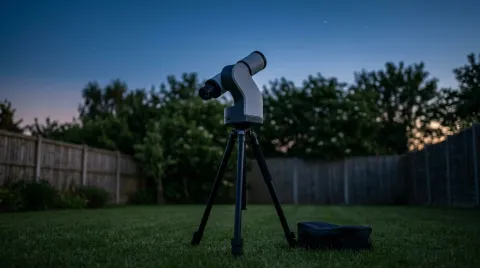
Celestron Origin Mark II
6.6/10 research score152 mm f/2.2 RASA, Sony IMX678, dew heater and filter drawer, for $4,299.
Vaonis
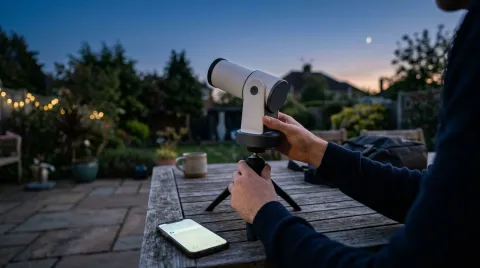
Vaonis Vespera Pro 2
7.2/10 research score50 mm apochromat, 12.5 MP square sensor, 11-hour battery and 5-year warranty, for $2,990.
The short answer
The Origin Mark II gathers about nine times the light and is the better deep-sky imager if you observe from home. The Vespera Pro 2 is the better choice if you move your telescope: 11 lb against 41.6 lb, an 11-hour battery, a wider field and a 5-year warranty, for $1,309 less.
Both are premium, fully automatic smart telescopes for people who want results without building an astrophotography rig, but they take opposite approaches. Celestron's Origin Mark II maximizes light with a 6-inch f/2.2 RASA. Vaonis's Vespera Pro 2 maximizes refinement and portability with a 50 mm apochromat and a 12.5 MP sensor. We compared the makers' specs and reviews; we have not tested them ourselves. See how we research.
Specs side by side
| Spec | Celestron Origin Mark II | Vaonis Vespera Pro 2 |
|---|---|---|
| Optics | 152 mm RASA, 335 mm, f/2.2 | 50 mm apochromatic quadruplet, 245 mm, f/4.9 |
| Sensor | Sony IMX678, 8.3 MP, 2 µm | Sony IMX676, 12.5 MP square, 2 µm |
| Image scale | 1.23″ per pixel | 1.6″ per pixel |
| Field of view | 1.32° × 0.75° | 1.6° × 1.6° (mosaics to 4.18° × 2.45°) |
| Filters | Drawer for 1.25"/2" filters | Screw-on (CLS currently included) |
| Dew control | Heater ring, sensor and dew shield | Automatic anti-fog |
| Battery | "6+ hours"; runs on AC | 11 h |
| Storage | Raw frames to USB drive | 225 GB |
| Weight | 41.6 lb with tripod | 11 lb (tripod included) |
| Warranty | 2 years | 5 years |
| Price | $4,299 | $2,990 |
From celestron.com and vaonis.com, checked October 17, 2026.
Light-gathering
This is the Origin's decisive advantage. Its 152 mm aperture has about nine times the area of the Vespera's 50 mm, and at f/2.2 it builds images from 10-second frames. Space.com, testing the original Origin, got "crystal clear images of nebula and galaxies almost instantly". For faint galaxies the Origin will show more in less time.
Detail and field
The Origin's finer 1.23″ per pixel helps on small galaxies; the Vespera Pro 2 counters with a wider square field and mosaics up to 50 MP for large nebulae. Neither is a planetary instrument: reviewers of the original Origin couldn't focus on Saturn, and the Vespera's 245 mm focal length keeps planets small.
Portability and practicality
The Vespera Pro 2 is a single 5 kg unit with an 11-hour battery, a carbon-fiber tripod and a 5-year warranty. The Origin is three pieces weighing 41.6 lb together, with a "6+ hour" battery or mains power; reviewers also found its mount motors "fairly loud".
Which should you buy?
- Origin Mark II if you image from your backyard and want the deepest images any smart telescope can make. Read the review.
- Vespera Pro 2 if you'll travel to dark skies, value long battery life and warranty, or want a simpler setup.
Want deep-sky performance for less? The Dwarflab Draco offers 90 mm with guided 300 s exposures for $1,399; see best for deep sky.
| Spec | Celestron Celestron Origin Mark II | Vaonis Vaonis Vespera Pro 2 |
|---|---|---|
| Research score | 6.6/10 research score | 7.2/10 research score |
| List price | $4,299 | $2,990 |
| Optics | ||
| Aperture | 152 mm (best) | 50 mm |
| Focal length | 335 mm (best) | 245 mm |
| Focal ratio | f/2.2 (best) | f/4.9 |
| Optics | Rowe-Ackermann Schmidt Astrograph (RASA), StarBright XLT coatings | Apochromatic quadruplet (S-FPL52 lanthanum glass) with refined field corrector |
| Field of view | 1.32° × 0.75° | 1.6° × 1.6° (up to 4.18° × 2.45° in mosaic) |
| Camera | ||
| Image sensor | Sony IMX678 Starvis 2 (Origin 678C camera) | Sony IMX676, 1/1.6 in (square) |
| Sensor resolution | 8.3 MP | 12.5 MP (best) |
| Pixel size | 2 µm | 2 µm |
| Wide-angle camera | Not published | No |
| RAW / FITS files | Yes | Yes |
| Filters and imaging | ||
| Light-pollution filter | No | No |
| Solar filter included | No | No |
| Mount and tracking | ||
| Equatorial mode | Yes | Not published |
| Autofocus | Yes | Not published |
| Dew heater | Yes | Yes |
| Eyepiece | No | No |
| Power and storage | ||
| Battery life | 6 h | 11 h (best) |
| Built-in storage | Not published | 225 GB |
| Connectivity | Built-in Wi-Fi network, Ethernet, USB-A | Not published |
| Size and warranty | ||
| Weight | 27.6 lb | 11.02 lb (best) |
| Dimensions | Tube 24 × 7 in; assembled 24 × 26 × 48 in | 48 × 20 × 9 cm |
| Warranty | 2 years | 5 years (best) |
| Where to buy | Check price at Celestron (opens in a new tab) | Check price at Vaonis (opens in a new tab) |
Frequently asked questions
Which takes better pictures, the Origin or the Vespera Pro 2?
Which is easier to set up?
Can I take either to a dark site?
Sources
Specs, prices and claims in this article come from these sources.
- Celestron Origin Mark II specifications · Celestron · accessed Oct 17, 2026
- Celestron Origin Intelligent Home Observatory review · Space.com · accessed Oct 18, 2026
- Vespera Pro 2 technical specifications · Vaonis · accessed Oct 17, 2026
- Vespera 3 and Vespera Pro 2: What's New · Vaonis · accessed Oct 18, 2026
Written by
SmartTelescopes editorial team
Research and editing
The SmartTelescopes editorial team researches smart telescopes from manufacturer documents, published measurements and owner reports.