Review
Celestron Origin Mark II Review: The Biggest Smart Telescope
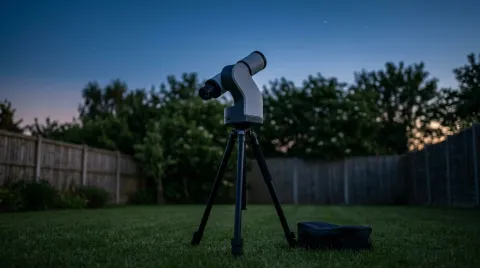
Celestron's Origin Mark II is a 6-inch f/2.2 RASA "home observatory" with a new Sony IMX678 camera, autofocus, a dew heater and a filter drawer, on a fork mount and full-height tripod. We compare its specs with what reviewers found on the original Origin.
This page contains affiliate links; we may earn from purchases made through them. Learn more

Celestron
Celestron Origin Mark II
List price $4,299 (as of Oct 2026)
Best for: Faint galaxies and nebulae from a backyard
Our verdict
Nothing else here gathers light like a 152 mm f/2.2 RASA: faint galaxies and nebulae show up in seconds-long frames, and setup is largely automatic. But it weighs 41.6 lb with the tripod, costs $4,299, and reviewers of the original Origin could not get a sharp image of Saturn. Buy it for backyard deep-sky imaging, not travel or planets.
The Celestron Origin is the heavyweight of smart telescopes. Where most rivals use 30–50 mm lenses, Origin uses a 152 mm (6-inch) Rowe-Ackermann Schmidt Astrograph (RASA) at f/2.2, a design that puts the camera at the front of the tube and collects light far faster than a small refractor. The Mark II, item #12100, adds Celestron's 678C camera with a Sony IMX678 sensor. It costs $4,299. We compared Celestron's published specs with hands-on reviews of the original Origin, which shares the optics, mount and app. We have not tested it ourselves; see how we research.
Key specs
| Spec | Origin Mark II |
|---|---|
| Optics | 152 mm RASA, 335 mm focal length, f/2.2 |
| Camera | Sony IMX678 Starvis 2, 8.3 MP (3856 × 2180), 2 µm pixels |
| Field of view | 1.32° × 0.75° (1.23 arcsec/pixel) |
| Focus | Autofocus or manual |
| Dew control | Heater ring in the front lens, environmental sensor, dew shield |
| Filters | Integrated drawer for 1.25" or 2" filters |
| Computer | Raspberry Pi 4 Model B with Wi-Fi; Ethernet and USB ports |
| Battery | 97.9 Wh LiFePO4, "6+ hours"; 12 V adapter for AC power |
| Weight | Tube 10.6 lb, mount 17 lb, tripod 14 lb (41.6 lb total) |
| Warranty | 2 years |
| Price | $4,299 |
Specs from Celestron's product page, checked October 17, 2026.
Image quality
f/2.2 is the key number. A RASA collects light so quickly that Origin builds images from 10-second exposures and rejects frames with tracking errors. Space.com and Live Science, testing the original Origin under Bortle 4 skies, got "crystal clear images of nebula and galaxies almost instantly", with "no noise" visible and stars as "pinpoints with no color fringes", even without a filter. The Mark II's IMX678 has smaller 2 µm pixels and higher resolution than the original IMX178 camera; Celestron says owners of the original can buy the 678C as an upgrade.
Planets and the Moon
Origin is a deep-sky instrument. Both reviews managed sharp Moon images in manual "Snapshot" mode, but neither could get Saturn to focus in auto or manual mode. Space.com's verdict: Origin "isn't going to be your go-to for viewing the moon or the planets".
Setup and the app
Celestron's StarSense camera aligns the telescope automatically, and focus is automatic. The reviewers had the original Origin connected "in seconds" and found targeting, tracking and focusing worked "without issue". Several people can watch the live view at once, which suits families and star parties. The app is minimalist, with few manual controls; the reviewers found manual focus slow to respond, with no fine adjustment, and the mount motors "fairly loud".
Weight and setup
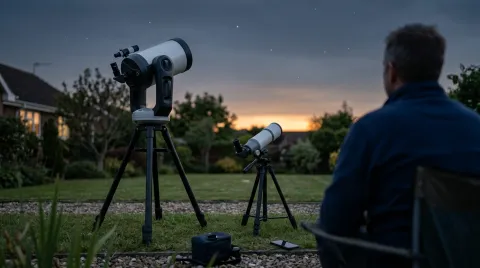
Origin is three pieces: a 10.6 lb tube, a 17 lb mount and a 14 lb tripod, 41.6 lb in total. The reviewers found the tripod sturdy and the mount's carrying handles useful, and recommend a padded bag for the tube. It runs from its internal battery for 6-plus hours or from mains power. Celestron says it fits "in any car", but this is a backyard scope, not a travel one.
Upgrades and advanced use
Celestron keeps adding features through software: dithering arrived in April 2026 and a mosaic mode in September 2026. For longer exposures you can add an equatorial wedge; Celestron recommends its StarSense Autoguider beyond 30 seconds. Raw frames save to a USB drive for processing on a computer.
Who should buy it
- Buy it if you image from a backyard or a short drive away and want the most light-gathering of any smart telescope, with room to grow.
- Look at the Dwarflab Draco if you want guided long exposures and 90 mm of aperture in a 12 lb package for about a third of the price.
- Choose a Seestar S50 Pro if you need something portable for under $1,000.
If your images come out soft, start with our blurry image checklist.
How the Celestron Origin Mark II scores
6.6/10 Fair research score- Image quality
- 9.0
- 152 mm at f/2.2 collects far more light than any other model here; 1.23 arcsec/pixel.
- Versatility
- 6.0
- Excellent on deep sky; the fast RASA is not suited to planetary detail and there is no solar filter in the box.
- Ease of use
- 7.0
- StarSense auto-alignment, autofocus and real-time stacking, but three heavy pieces to carry and assemble.
- Portability
- 3.0
- 41.6 lb with tripod; Celestron says it fits in any car.
- Features
- 7.0
- Dew heater, filter drawer, raw files, autofocus, Ethernet and scheduled sessions.
- Reliability
- 6.0
- 2-year warranty and regular software updates (dithering, mosaic mode added in 2026).
- Value
- 5.0
- $4,299 is a lot, but 152 mm f/2.2 has no smart-telescope equal.
Scores come from published specs, owner reports and expert reviews, weighted by what matters most for imaging the night sky. How we score
Pros
- 152 mm f/2.2 RASA, the fastest optics here
- Dew heater and filter drawer
- Raw frames for processing
- Full-height tripod included
Cons
- 41.6 lb with the tripod
- $4,299
- Not suited to planetary detail
| Spec | Celestron Celestron Origin Mark II |
|---|---|
| Research score | 6.6/10 research score |
| List price | $4,299 |
| Optics | |
| Aperture | 152 mm |
| Focal length | 335 mm |
| Focal ratio | f/2.2 |
| Optics | Rowe-Ackermann Schmidt Astrograph (RASA), StarBright XLT coatings |
| Field of view | 1.32° × 0.75° |
| Camera | |
| Image sensor | Sony IMX678 Starvis 2 (Origin 678C camera) |
| Sensor resolution | 8.3 MP |
| Pixel size | 2 µm |
| RAW / FITS files | Yes |
| Filters and imaging | |
| Light-pollution filter | No |
| Solar filter included | No |
| Mount and tracking | |
| Equatorial mode | Yes |
| Autofocus | Yes |
| Dew heater | Yes |
| Eyepiece | No |
| Power and storage | |
| Battery life | 6 h |
| Connectivity | Built-in Wi-Fi network, Ethernet, USB-A |
| Size and warranty | |
| Weight | 27.6 lb |
| Dimensions | Tube 24 × 7 in; assembled 24 × 26 × 48 in |
| Warranty | 2 years |
| Where to buy | Check price at Celestron (opens in a new tab) |
Frequently asked questions
What is the difference between the Celestron Origin and the Origin Mark II?
How heavy is the Celestron Origin?
Can the Celestron Origin photograph planets?
Does the Origin work in light-polluted skies?
Sources
Specs, prices and claims in this article come from these sources.
- Celestron Origin Mark II product page and specifications · Celestron · accessed Oct 17, 2026
- Celestron Origin Intelligent Home Observatory smart telescope review · Space.com · accessed Oct 18, 2026
- Celestron Origin Intelligent Home Observatory review · Live Science · accessed Oct 18, 2026
Written by
SmartTelescopes editorial team
Research and editing
The SmartTelescopes editorial team researches smart telescopes from manufacturer documents, published measurements and owner reports.