Review
DWARF 3 Review: The Best-Value Travel Smart Telescope
Dwarflab's 3 lb DWARF 3 has a 35 mm apochromatic lens, a Sony IMX678 sensor, three built-in filters including dual-band, EQ mode with 60-second exposures and a 10,000 mAh battery for $549. We compare its published specs with what hands-on reviewers found.
This page contains affiliate links; we may earn from purchases made through them. Learn more

Dwarflab
DWARF 3
List price $549 (as of Oct 2026)
Best for: Portable deep-sky imaging and travel for under $600
Our verdict
The most smart-telescope equipment for the money: light enough for a camera bag, a built-in dual-band filter, a solar filter in the box and real EQ mode. Reviewers' main complaints are early connection problems, an app with a learning curve and no tripod in the box. Planets stay tiny at 150 mm.
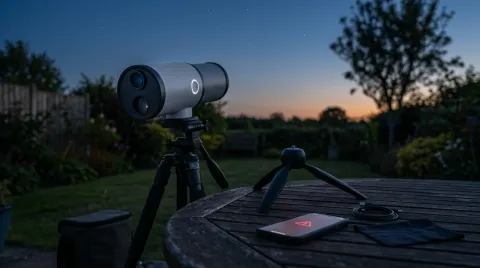
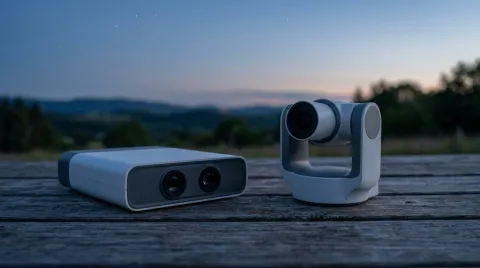
The DWARF 3 is a 1.35 kg (3 lb) smart telescope ("dictionary size", as Dwarflab puts it) with a telephoto camera and a wide-angle camera side by side. For $549 it includes three switchable filters, a solar filter, EQ mode and 128 GB of storage, a long list for the price. We compared Dwarflab's published specs with what reviewers found. We have not tested it ourselves; see how we research.
Key specs
| Spec | DWARF 3 |
|---|---|
| Aperture / focal length | 35 mm / 150 mm (about f/4.3) |
| Main sensor | Sony IMX678 Starvis 2, 1/1.8 in, 8 MP, 2 µm pixels |
| Wide-angle camera | 2 MP, 45 mm equivalent |
| Field of view | 3.38° diagonal (telephoto) |
| Built-in filters | VIS, astro (IR-extended), dual-band OIII + Hα |
| Longest exposure | 60 s in EQ mode |
| Battery | 10,000 mAh; up to 5.5 h measured average |
| Storage | 128 GB (about 100–110 GB usable) |
| Connection | Wi-Fi and Bluetooth, up to 20 m |
| Weight | 1.35 kg (3 lb) |
| Operating range | -10 °C to 45 °C; IP54 |
| Warranty | 2 years |
| Price | $549 (tripod not included) |
Specs from Dwarflab's product page and help center, checked October 17–18, 2026.
Image quality
With a 35 mm lens the DWARF 3 gathers a little more light than 30 mm rivals such as the Seestar S30 Pro, but its 1/1.8-inch sensor is smaller than the S30 Pro's 1/1.2-inch chip, so the S30 Pro covers more sky at the same resolution. Digital Camera World found it delivers "strong deep-sky, solar and lunar images". T3 called its images "spectacular, albeit small" and "fine for sharing and social media". Galactic Hunter's verdict was that image quality "still can't match a dedicated astrophotography rig", but that it is the "smallest yet most versatile smart telescope".
Dwarflab says the DWARF 3 dithers automatically (shifts slightly between frames) to reduce noise patterns, and both reviewers and Dwarflab stress taking fresh dark frames; the app prompts you to.
Filters and light pollution
The three filters switch automatically: VIS for daytime, an IR-extended astro filter, and a dual-band OIII + Hα filter for emission nebulae from light-polluted skies. Galactic Hunter found the scope picks the filter itself when it slews to a target. You can't add or swap filters.
EQ mode
EQ mode lets the DWARF 3 track like an equatorial mount and take exposures up to 60 seconds instead of short alt-az frames. Galactic Hunter found polar alignment took "a couple of minutes" and stars on the Veil Nebula stayed "round and pinpoint". A sturdy tripod helps; Digital Camera World found it "much easier on a tall tripod".
Connection and app
This is the weak spot in reviews. Digital Camera World said "connectivity issues between the smartphone and telescope dogged early review sessions". T3 had trouble connecting consistently and had to switch off Wi-Fi to get a stable link; firmware updates "came thick and fast but installed smoothly". The Gadgeteer found the app hard to learn without the long manual. Dwarflab publishes connection error codes and fixes; see our Dwarflab error codes guide.
What reviewers didn't like
- No tripod (every review) and only a drawstring bag for the solar filter (Digital Camera World).
- Connection problems in early sessions (Digital Camera World, T3).
- Learning curve in the app (The Gadgeteer).
- Planets are tiny (T3, Galactic Hunter, Dwarflab).
Who should buy it
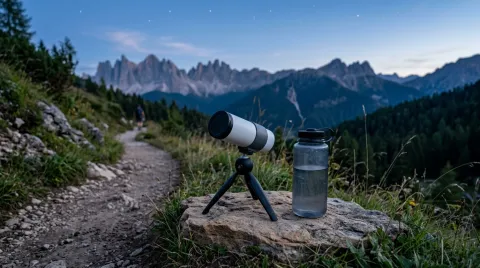
- Buy it if you want the most capable scope you can fit in a camera bag for around $550, especially for travel to dark skies.
- Choose the Seestar S30 Pro if you want a larger 4K sensor, an easier app with a larger community and a tripod in the box.
- Choose the DWARF mini if weight matters most: it is 840 g.
How the DWARF 3 scores
7.6/10 Good research score- Image quality
- 6.0
- 35 mm apochromatic lens with an 8 MP Starvis 2 sensor and up to 60 s frames; a step below 50 mm scopes on faint targets.
- Versatility
- 8.0
- Wide-angle camera, solar filter in the box, mosaic, panorama, time-lapse and EQ mode; planets stay small at 150 mm.
- Ease of use
- 8.0
- Automatic GoTo, focus and stacking in the DWARFLAB app; fewer guides and owners online than Seestar.
- Portability
- 9.0
- 3 lb with a 5.5-hour battery.
- Features
- 8.0
- Three built-in filters including dual-band, 128 GB storage, FITS/TIFF files and a wide-angle camera.
- Reliability
- 6.0
- 2-year warranty; error codes and firmware updates are among the most-searched Dwarflab problems.
- Value
- 9.0
- $549 with a solar filter, dual-band filter and 60 s exposures.
Scores come from published specs, owner reports and expert reviews, weighted by what matters most for imaging the night sky. How we score
Pros
- 3 lb with a 5.5-hour battery
- Built-in dual-band filter
- Up to 60 s exposures in EQ mode
- Solar filter in the box
Cons
- 35 mm aperture and 150 mm focal length
- Smaller help community than Seestar
- Error codes are a common search
| Spec | Dwarflab DWARF 3 |
|---|---|
| Research score | 7.6/10 research score |
| List price | $549 |
| Optics | |
| Aperture | 35 mm |
| Focal length | 150 mm |
| Focal ratio | f/4.3 |
| Optics | Apochromatic dual-camera lens group |
| Field of view | 3.38° diagonal (telephoto), 50.6° (wide-angle) |
| Camera | |
| Image sensor | Sony IMX678 Starvis 2, 1/1.8 in |
| Sensor resolution | 8 MP |
| Pixel size | 2 µm |
| Wide-angle camera | Yes |
| RAW / FITS files | Yes |
| Filters and imaging | |
| Light-pollution filter | Yes |
| Built-in filters | VIS, astro (IR-extended), dual-band (OIII/Hα) |
| Solar filter included | Yes |
| Longest single exposure | 60 s |
| Mount and tracking | |
| Equatorial mode | Yes |
| Field derotation | No |
| Eyepiece | No |
| Power and storage | |
| Battery life | 5.5 h |
| Battery capacity | 10,000 mAh |
| Built-in storage | 128 GB |
| Connectivity | Wi-Fi and Bluetooth (up to 20 m) |
| Size and warranty | |
| Weight | 2.98 lb |
| Dimensions | 222 × 142 × 65 mm |
| Operating temperature | -10 °C to 45 °C |
| Warranty | 2 years |
| Where to buy | Check price at Dwarflab (opens in a new tab) |
Frequently asked questions
Does the DWARF 3 come with a tripod?
How long does the DWARF 3 battery last?
Can the DWARF 3 photograph Jupiter and Saturn?
Can I add my own filters to the DWARF 3?
Sources
Specs, prices and claims in this article come from these sources.
- DWARF 3 product page and specifications · Dwarflab · accessed Oct 17, 2026
- FAQ & Troubleshooting Guide for DWARF Users · Dwarflab · accessed Oct 18, 2026
- DwarfLab Dwarf 3 smart telescope review · Digital Camera World · accessed Oct 18, 2026
- DwarfLab Dwarf 3 Smart Telescope review · T3 · accessed Oct 18, 2026
- DWARF 3 review · Galactic Hunter · accessed Oct 18, 2026
- DWARFLAB DWARF 3 smart telescope review · The Gadgeteer · accessed Oct 18, 2026
Written by
SmartTelescopes editorial team
Research and editing
The SmartTelescopes editorial team researches smart telescopes from manufacturer documents, published measurements and owner reports.