Review
DWARF mini Review: The Lightest Smart Telescope You Can Buy
At 840 g, the DWARF mini packs a 30 mm lens, a Sony IMX662 sensor, a dual narrowband filter, a wide-angle camera and EQ mode into a body 18 cm tall, for $419. We compare its published specs with what reviewers found.
This page contains affiliate links; we may earn from purchases made through them. Learn more

Dwarflab
DWARF mini
List price $419 (as of Oct 2026)
Best for: Hiking, flying and the lightest possible kit
Our verdict
A brilliant travel and starter scope: it weighs 840 g, needs no extra wedge for EQ mode and produces surprisingly good nebula images. The limits are its 2 MP images, a 4-hour battery and planets that stay tiny. For $130 more the DWARF 3 has a much better sensor.
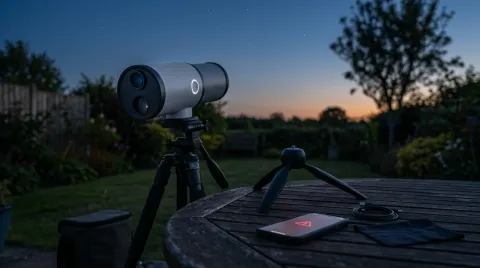
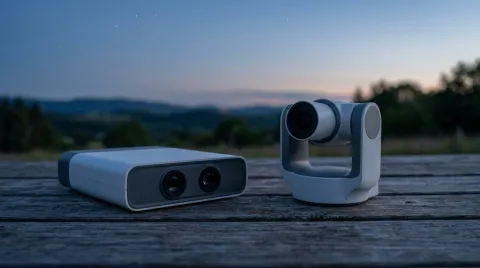
The DWARF mini is the smallest full smart telescope on this site: 840 g (1.85 lb) and about 18 cm tall, with a telephoto camera, a wide-angle camera, three filters, GoTo tracking and EQ mode inside. At $419 it is also one of the cheapest. We compared Dwarflab's published specs with what reviewers found. We have not tested it ourselves; see how we research.
Key specs
| Spec | DWARF mini |
|---|---|
| Aperture / focal length | 30 mm / 150 mm (f/5) |
| Main sensor | Sony IMX662, 1/2.8 in, 2.07 MP, 2.9 µm pixels |
| Wide-angle camera | 2.07 MP |
| Field of view | 2.45° diagonal (telephoto) |
| Built-in filters | Astro, dark, dual narrowband (Hα + OIII) |
| Longest exposure | 90 s in EQ mode (Dwarflab) |
| Battery | 7,000 mAh, about 4 h |
| Storage | 64 GB |
| Connection | Wi-Fi (up to 15 m), Bluetooth 5.0 |
| Weight | 840 g (1.85 lb) |
| Operating range | -20 °C to 45 °C |
| Warranty | 2 years |
| Price | from $419 (no tripod) |
Specs from Dwarflab's product page and comparison page, checked October 17, 2026.
Image quality
The DWARF mini's 2.07 MP resolution is its biggest limit, and every review says so. AstroBackyard argues the sensor's large 2.9 µm pixels and low noise "matter more than megapixel count for deep-sky work", and called its Pleiades image "one of the most impressive" it had seen from a smart telescope in its class. The trade-off is "limited room to crop" and images too small for big prints. High Point Scientific (a retailer that sells it) calls the 2.1 MP resolution the main limitation; mosaic mode can produce images up to 1.8 times the native size.
EQ mode
This is the mini's standout feature. Dwarflab rates it for 90-second exposures in equatorial mode; High Point Scientific reports up to 120 seconds and captured 4 hours of the Pinwheel Galaxy (M101) in 60-second frames. Polar alignment took under five minutes. AstroBackyard notes the app plate-solves the field, so you don't need a view of Polaris, but warns that wind and imperfect alignment still cause rejected frames, so lengthen exposures only "when the stars remain round". Unlike the Seestar S30, the mini needs no extra wedge for EQ mode (AstroBackyard).
Battery and power
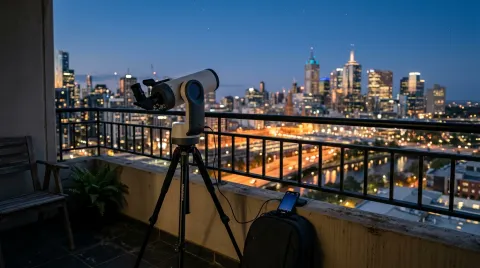
The 7,000 mAh battery gives about 4 hours, less in cold weather. It can image while charging from USB-C, so a power bank keeps it going all night.
What reviewers didn't like
- 2 MP images limit cropping and printing (all reviews).
- Planets look tiny at 150 mm (AstroBackyard).
- No tripod or case in the box (High Point Scientific, AstroBackyard).
- Closed system: fixed optics and an app-driven workflow (AstroBackyard).
- Star trail mode lacked preloaded dark frames, causing vignetting in early tests (High Point Scientific).
Who should buy it
- Buy it if you want something you can pack for a flight or a hike and still image nebulae with EQ mode, or as a second scope.
- Choose the DWARF 3 for an 8 MP sensor, 128 GB and 5.5 hours of battery for $130 more.
- Choose the Seestar S30 Pro for 4K images and anti-dew control, if 1.65 kg is acceptable.
How the DWARF mini scores
7.0/10 Good research score- Image quality
- 5.0
- 30 mm lens with a 2.07 MP sensor: bright nebulae and clusters, but the smallest images here.
- Versatility
- 7.0
- Wide-angle camera, solar ND filter, mosaics, eclipses and ISS transits; 150 mm limits planets.
- Ease of use
- 8.0
- Automatic focus, GoTo and stacking; scheduled overnight shooting.
- Portability
- 10.0
- 1.85 lb, the lightest model on this site.
- Features
- 7.0
- Dual narrowband and dark filters, FITS/TIFF, wide-angle camera, 64 GB; 4-hour battery.
- Reliability
- 6.0
- 2-year warranty; little long-term owner data so far.
- Value
- 8.0
- $419 including a solar filter, but the DWARF 3 adds a far better sensor for $130 more.
Scores come from published specs, owner reports and expert reviews, weighted by what matters most for imaging the night sky. How we score
Pros
- Only 840 g (1.85 lb)
- Built-in dual narrowband filter
- EQ mode with up to 90 s exposures
- Solar ND filter included
Cons
- 2.07 MP sensor
- 4-hour battery
- 150 mm focal length for planets
| Spec | Dwarflab DWARF mini |
|---|---|
| Research score | 7.0/10 research score |
| List price | $419 |
| Optics | |
| Aperture | 30 mm |
| Focal length | 150 mm |
| Focal ratio | f/5 |
| Optics | Telephoto lens |
| Field of view | 2.45° diagonal (telephoto), 50.59° diagonal (wide-angle) |
| Camera | |
| Image sensor | Sony IMX662, 1/2.8 in |
| Sensor resolution | 2.1 MP |
| Pixel size | 2.9 µm |
| Wide-angle camera | Yes |
| RAW / FITS files | Yes |
| Filters and imaging | |
| Light-pollution filter | Yes |
| Built-in filters | Astro, dark-frame, dual narrowband |
| Solar filter included | Yes |
| Longest single exposure | 90 s |
| Mount and tracking | |
| Equatorial mode | Yes |
| Field derotation | No |
| Autofocus | Yes |
| Eyepiece | No |
| Power and storage | |
| Battery life | 4 h |
| Battery capacity | 7,000 mAh |
| Built-in storage | 64 GB |
| Connectivity | Wi-Fi (up to 15 m), Bluetooth 5.0 |
| Size and warranty | |
| Weight | 1.85 lb |
| Dimensions | 100.4 × 183.6 × 60.7 mm |
| Operating temperature | -20 °C to 45 °C |
| Warranty | 2 years |
| Where to buy | Check price at Dwarflab (opens in a new tab) |
Frequently asked questions
How long does the DWARF mini battery last?
Does the DWARF mini need a wedge for EQ mode?
What is the difference between the DWARF mini and DWARF 3?
Is a tripod included with the DWARF mini?
Sources
Specs, prices and claims in this article come from these sources.
- DWARF mini product page · Dwarflab · accessed Oct 17, 2026
- DWARF product comparison (specifications) · Dwarflab · accessed Oct 17, 2026
- DWARF mini review · AstroBackyard · accessed Oct 18, 2026
- DWARF Mini Smart Telescope: Full Review · High Point Scientific · accessed Oct 18, 2026
- DWARFLAB DWARF mini review · TelescopicWatch · accessed Oct 18, 2026
Written by
SmartTelescopes editorial team
Research and editing
The SmartTelescopes editorial team researches smart telescopes from manufacturer documents, published measurements and owner reports.