Review
Unistellar Odyssey Pro Review: Easy, With an Eyepiece, Priced High
Unistellar's Odyssey Pro adds a Nikon-developed electronic eyepiece to the 85 mm Odyssey. We compare its published specs with what Sky at Night Magazine, Popular Science and other hands-on reviewers found, and ask whether the eyepiece is worth $2,000.
This page contains affiliate links; we may earn from purchases made through them. Learn more
Unistellar
Unistellar Odyssey Pro
List price $4,599 (as of Oct 2026)
Best for: Outreach and groups who want to look through an eyepiece
Our verdict
One of the easiest smart telescopes to set up, with clean deep-sky views even under light pollution and an eyepiece that makes it feel like a real telescope. But the eyepiece is the only difference from the $2,599 Odyssey, and at $4,599 the Pro has no built-in filters, no EQ mode and a 5-hour battery. Buy it for outreach and groups; otherwise the Odyssey, or a Seestar S50 Pro or Vespera 3, is better value.
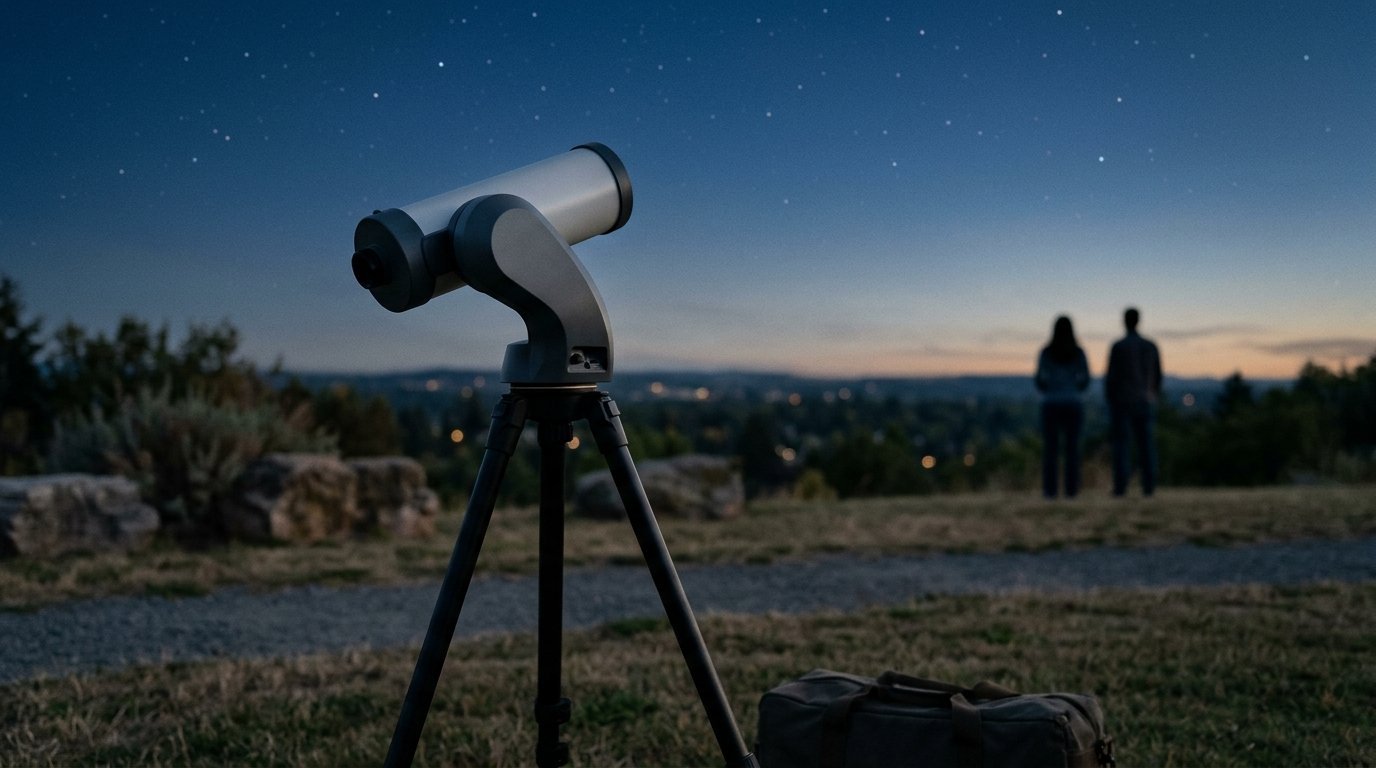
Unistellar's Odyssey Pro is the smart telescope for people who still want to put an eye to a telescope. It's the 85 mm Odyssey with an electronic eyepiece developed with Nikon added on top, so a group can take turns looking at a galaxy building up in real time instead of crowding around a phone. That makes it charming, and expensive. Here's how its published specs compare with what hands-on reviewers found; we haven't tested it ourselves, see how we research.
Key specs
| Spec | Unistellar Odyssey Pro |
|---|---|
| Optics | 85 mm Newtonian reflector |
| Focal length / ratio | 320 mm, f/3.9 |
| Field of view | 33.6 × 45 arcmin |
| Eyepiece | Electronic (OLED), developed with Nikon |
| Light pollution | Software (Deep Dark Technology), no filter |
| Mount | Motorized alt-azimuth, no EQ mode |
| Battery | About 5 hours |
| Storage | 64 GB |
| Weight | 4 kg (8.8 lb) |
| Solar filter | Sold separately |
| Warranty | 2 years; 6 months on the battery |
| US list price | $4,599 (October 2026) |
Setup: as easy as it gets
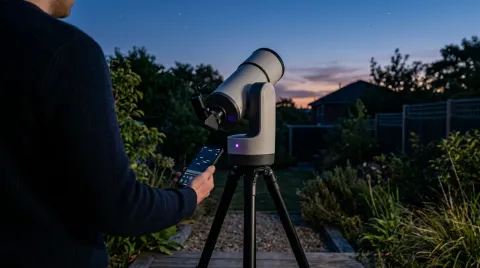
Every reviewer praised the setup. Sky at Night Magazine's Paul Money called assembly the fastest he'd had with a review telescope: there's no collimation, and the telescope focuses, plate-solves and finds targets by itself. Popular Science described leveling the tripod with its built-in bubble level, pairing it with the app and letting it orient itself by recognizing stars, which takes a minute or two. Pairing was the one step Popular Science found "a bit finicky".
The eyepiece
The eyepiece isn't optical: it's an OLED micro-display showing the camera's processed image, so you see the same stacked, enhanced view as in the app. Sky at Night found it gives a bright, clear view as the image builds up, with a small focus wheel to suit your eye. Popular Science called the experience "something special", and it's the reason to buy the Pro: at star parties and with family it feels like looking through a telescope, not at a screen.
Image quality
Sky at Night captured galaxies such as the Whirlpool, Bode's and the Cigar, plus the Dumbbell and Bubble nebulae and several star clusters. It noted that a dim first view usually improves within about a minute of stacking, and that large targets like the Double Cluster "only just fitted" the field of view. Raw data can be downloaded, and Sky at Night got "far better" results processing it on a laptop than from the app's standard output.
Under light pollution, Popular Science credited Deep Dark Technology with a truly black background and strong results from a bright area, while noting it won't match a dedicated astrophotography setup. Unlike the Seestar and DWARF telescopes, there's no physical dual-band filter for nebulae.
For the best stars, Unistellar recommends letting the Odyssey cool to the outside temperature for at least 30 minutes before orienting it; see blurry smart telescope images.
What reviewers didn't like
- Price. Every reviewer named it as the biggest downside. Popular Science found the eyepiece hard to justify for the difference over the plain Odyssey, and that gap is now $2,000 at US list prices.
- Phone dependence. There are no controls on the telescope, so it needs your phone or tablet throughout. Popular Science warns that a dead phone mid-session can stop you parking the scope, and Sky at Night notes it ties up a device.
- Storage and Wi-Fi. Popular Science found the 64 GB fills faster than expected and the Wi-Fi range shorter than it wanted.
- Battery. About 5 hours, with only 6 months of warranty on the battery itself.
- Fixed sensor and small mirror. Sky at Night points out the sensor can't be upgraded, and the 85 mm mirror is smaller than the 114 mm in Unistellar's Expert range.
Odyssey Pro vs Odyssey: is the eyepiece worth it?
The two share the same 85 mm optics, battery, storage and app; see the Unistellar Odyssey range. For most owners who view on a phone or tablet anyway, the standard Odyssey gives identical images for $2,000 less. The Pro makes sense for outreach events, schools and families who want people to look into a telescope, or for anyone who simply values that experience.
Alternatives
- Seestar S50 Pro ($999). A built-in dual-band filter, EQ mode and a 9-hour battery for a fraction of the price; see our Seestar S50 Pro review.
- Vaonis Vespera 3 ($2,490). A premium refractor with an 11-hour battery and 5-year warranty; see our Vespera 3 review.
- Unistellar vs Vaonis: our full comparison of mirrors vs lenses at $2,500 to $5,000.
Who should buy it
Buy the Odyssey Pro if you run public outreach, teach, or want the whole family to look through an eyepiece, and the price isn't a stretch. Everyone else gets the same images from the Odyssey, or more features for less from a Seestar S50 Pro or Vespera 3. Compare everything in our best smart telescopes.
How the Unistellar Odyssey Pro scores
6.5/10 Fair research score- Image quality
- 7.0
- Same 85 mm f/3.9 optics as the Odyssey.
- Versatility
- 7.0
- Eyepiece viewing plus phone viewing; no EQ mode and the solar filter is extra.
- Ease of use
- 9.0
- Automatic alignment; the eyepiece makes it intuitive for groups.
- Portability
- 7.0
- 8.8 lb with a 5-hour battery.
- Features
- 6.0
- Nikon electronic eyepiece; no built-in filters, published RAW output or dew heater.
- Reliability
- 6.0
- 2-year warranty but only 6 months on the battery; error codes and firmware updates are the most-searched Unistellar problems.
- Value
- 3.0
- $4,599, or $2,000 more than the Odyssey for the eyepiece alone.
Scores come from published specs, owner reports and expert reviews, weighted by what matters most for imaging the night sky. How we score
Pros
- Nikon electronic eyepiece
- 85 mm f/3.9 mirror
- Automatic alignment
Cons
- $2,000 more than the identical Odyssey
- No built-in filters
- No EQ mode
| Spec | Unistellar Unistellar Odyssey Pro |
|---|---|
| Research score | 6.5/10 research score |
| List price | $4,599 |
| Optics | |
| Aperture | 85 mm |
| Focal length | 320 mm |
| Focal ratio | f/3.9 |
| Optics | 85 mm mirror |
| Field of view | 33.6 × 45 arcmin |
| Camera | |
| Pixel size | 1.45 µm |
| Filters and imaging | |
| Light-pollution filter | No |
| Solar filter included | No |
| Mount and tracking | |
| Equatorial mode | No |
| Eyepiece | Yes |
| Power and storage | |
| Battery life | 5 h |
| Built-in storage | 64 GB |
| Connectivity | Wi-Fi |
| Size and warranty | |
| Weight | 8.82 lb |
| Warranty | 2 years |
| Where to buy | Check price at Unistellar (opens in a new tab) |
Frequently asked questions
What is the difference between the Unistellar Odyssey and Odyssey Pro?
Is the Odyssey Pro eyepiece a real optical eyepiece?
Does the Odyssey Pro work in light-polluted skies?
How long does the Odyssey Pro battery last?
Does the Odyssey Pro include a solar filter?
Sources
Specs, prices and claims in this article come from these sources.
- Unistellar Odyssey range specifications · Unistellar · accessed Oct 18, 2026
- Unistellar Odyssey Pro review · BBC Sky at Night Magazine · accessed Oct 25, 2026
- Unistellar Odyssey Pro smart telescope review · Popular Science · accessed Oct 25, 2026
- About Unistellar warranty · Unistellar · accessed Oct 17, 2026
- ODYSSEY and ODYSSEY PRO: my images are blurry · Unistellar · accessed Oct 17, 2026
Written by
SmartTelescopes editorial team
Research and editing
The SmartTelescopes editorial team researches smart telescopes from manufacturer documents, published measurements and owner reports.