Comparison
DWARF 3 vs DWARF mini: Is the Bigger DWARF Worth $130 More?
Dwarflab's two small smart telescopes compared: sensor, lens, filters, EQ mode, battery, storage, weight and what reviewers found, for $549 and $419.
This page contains affiliate links; we may earn from purchases made through them. Learn more

Our pick
Dwarflab
DWARF 3
7.6/10 research score8 MP IMX678, 35 mm lens, 128 GB and up to 5.5 hours, for $549.
Dwarflab
DWARF mini
7.0/10 research score840 g with EQ mode up to 90 s, for $419; 2 MP images.
The short answer
The DWARF 3 is worth the extra $130 for most people: an 8 MP Sony IMX678 sensor instead of 2 MP, a 35 mm lens, 128 GB and a longer battery life. Choose the DWARF mini if weight is everything (840 g) or as a second, grab-and-go scope.
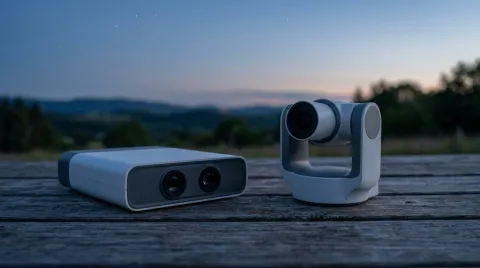
Dwarflab sells two small smart telescopes that look alike but differ inside. The DWARF 3 ($549) is the all-rounder; the DWARF mini ($419) is the smallest and lightest smart telescope we cover. We compared Dwarflab's specs with independent reviews; we have not tested them ourselves. See how we research.
Specs side by side
| Spec | DWARF 3 | DWARF mini |
|---|---|---|
| Aperture / focal length | 35 / 150 mm | 30 / 150 mm |
| Telephoto sensor | Sony IMX678, 1/1.8", 8 MP, 2 µm | Sony IMX662, 1/2.8", 2.07 MP, 2.9 µm |
| Wide-angle camera | 2 MP | 2.07 MP |
| Dual-band filter | OIII 20 nm / Hα 12 nm | 493 nm (30 nm) / 656 nm (15 nm) |
| Longest exposure (EQ) | 60 s | 90 s |
| Battery | 10,000 mAh, up to 5.5 h | 7,000 mAh, about 4 h |
| Storage | 128 GB | 64 GB |
| Wi-Fi range | up to 20 m | up to 15 m |
| Weight | 1.35 kg (3 lb) | 840 g (1.85 lb) |
| Operating temperature | -10 °C to 45 °C | -20 °C to 45 °C |
| Price | $549 | from $419 |
From Dwarflab's product and comparison pages, checked October 17, 2026. Both have a 2-year warranty, RAW (FITS/TIFF) files and automatic GoTo and stacking.
The sensor is the big difference
The DWARF 3's IMX678 has about four times the pixels of the mini's IMX662. AstroBackyard, which prefers the mini for its own travel use, still says the DWARF 3 is "the better all-rounder if you want more resolution". High Point Scientific (a retailer) lists the mini's "limited 2.1 MP resolution" as its main drawback. The mini's larger pixels are low-noise, and AstroBackyard was impressed by its Pleiades image, but you have little room to crop.
Where the mini wins
- Weight: 840 g against 1.35 kg. It's the one to pack for a flight or a hike.
- Longer EQ exposures: 90 seconds per Dwarflab, against 60 on the DWARF 3.
- Cold weather: rated down to -20 °C.
- Price: $130 less.
Which should you buy?
- DWARF 3 for better images, a bigger battery and storage. Read the review.
- DWARF mini if every gram counts, or as a second scope alongside a bigger one. Read the review.
Not set on Dwarflab? Compare the DWARF 3 vs Seestar S30 Pro.
| Spec | Dwarflab DWARF 3 | Dwarflab DWARF mini |
|---|---|---|
| Research score | 7.6/10 research score | 7.0/10 research score |
| List price | $549 | $419 |
| Optics | ||
| Aperture | 35 mm (best) | 30 mm |
| Focal length | 150 mm | 150 mm |
| Focal ratio | f/4.3 (best) | f/5 |
| Optics | Apochromatic dual-camera lens group | Telephoto lens |
| Field of view | 3.38° diagonal (telephoto), 50.6° (wide-angle) | 2.45° diagonal (telephoto), 50.59° diagonal (wide-angle) |
| Camera | ||
| Image sensor | Sony IMX678 Starvis 2, 1/1.8 in | Sony IMX662, 1/2.8 in |
| Sensor resolution | 8 MP (best) | 2.1 MP |
| Pixel size | 2 µm | 2.9 µm |
| Wide-angle camera | Yes | Yes |
| RAW / FITS files | Yes | Yes |
| Filters and imaging | ||
| Light-pollution filter | Yes | Yes |
| Built-in filters | VIS, astro (IR-extended), dual-band (OIII/Hα) | Astro, dark-frame, dual narrowband |
| Solar filter included | Yes | Yes |
| Longest single exposure | 60 s | 90 s (best) |
| Mount and tracking | ||
| Equatorial mode | Yes | Yes |
| Field derotation | No | No |
| Autofocus | Not published | Yes |
| Eyepiece | No | No |
| Power and storage | ||
| Battery life | 5.5 h (best) | 4 h |
| Battery capacity | 10,000 mAh (best) | 7,000 mAh |
| Built-in storage | 128 GB (best) | 64 GB |
| Connectivity | Wi-Fi and Bluetooth (up to 20 m) | Wi-Fi (up to 15 m), Bluetooth 5.0 |
| Size and warranty | ||
| Weight | 2.98 lb | 1.85 lb (best) |
| Dimensions | 222 × 142 × 65 mm | 100.4 × 183.6 × 60.7 mm |
| Operating temperature | -10 °C to 45 °C | -20 °C to 45 °C |
| Warranty | 2 years | 2 years |
| Where to buy | Check price at Dwarflab (opens in a new tab) | Check price at Dwarflab (opens in a new tab) |
Frequently asked questions
Which DWARF is better for astrophotography?
Can both DWARFs do EQ mode?
Do either come with a tripod?
Sources
Specs, prices and claims in this article come from these sources.
- DWARF product comparison · Dwarflab · accessed Oct 17, 2026
- DWARF 3 product page · Dwarflab · accessed Oct 17, 2026
- DWARF mini product page · Dwarflab · accessed Oct 17, 2026
- DWARF mini review · AstroBackyard · accessed Oct 18, 2026
- DWARF Mini Smart Telescope: Full Review · High Point Scientific · accessed Oct 18, 2026
- DWARF 3 review · Galactic Hunter · accessed Oct 18, 2026
Written by
SmartTelescopes editorial team
Research and editing
The SmartTelescopes editorial team researches smart telescopes from manufacturer documents, published measurements and owner reports.