Guide
Are Smart Telescopes Worth It? What You Get, What You Don't
An honest look at what a smart telescope does well, where it falls short of traditional telescopes and astrophotography rigs, what owning one really costs, and who should (and shouldn't) buy one.

In short
For most people who want to see and photograph galaxies and nebulae, especially from a city or with little time, a $550–$1,000 smart telescope is worth it: it replaces a mount, camera, computer and hours of learning. It's not worth it if you mainly want planets, love looking through an eyepiece, or want the most detailed images money can buy.
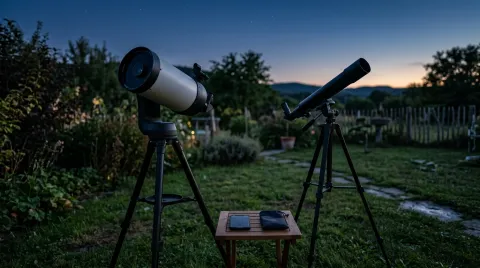
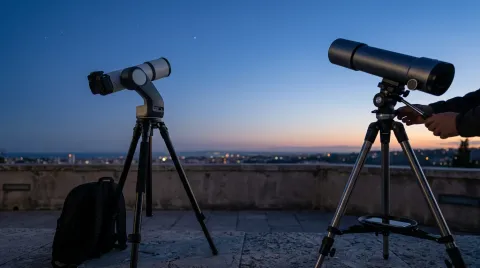
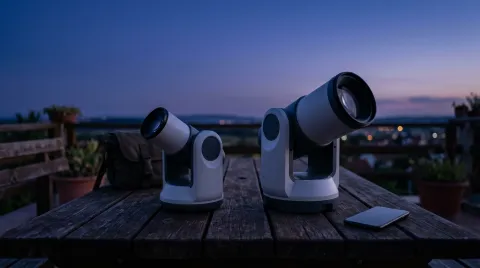
A smart telescope combines a small telescope, a camera, a motorized mount and a computer in one box, controlled from your phone. Turn it on, pick a target, and it finds, tracks and stacks exposures until a galaxy or nebula appears on your screen. Here's what that's worth, based on makers' specs, independent reviews and owner reports. We have not tested these telescopes ourselves; see how we research.
What smart telescopes do brilliantly
- Deep-sky objects in minutes. Nebulae, galaxies and star clusters that look like faint smudges through a beginner's eyepiece appear in color. Richard Harris, a veteran astrophotographer writing for ZWO, says he could get "a pleasing photo of the Andromeda Galaxy or the Orion Nebula in just a few minutes of stacking".
- Cities. Stacking and (on many models) built-in dual-band filters let you image emission nebulae under light-polluted skies.
- No learning curve to start. No polar alignment, star charts, focusing or processing needed. Digital Camera World had the S50 Pro stacking within five minutes of switching it on.
- Sharing. Images arrive on your phone, ready to share, and several models let others watch the live view.
Where they fall short
- Planets. Focal lengths of 150 to 450 mm make planets small. See best for planets.
- Ultimate detail. Harris is blunt: a 50 mm smart telescope "is not going to outperform a high-end setup". Dedicated rigs with larger optics and cooled monochrome cameras go deeper and sharper.
- The eyepiece experience. Only Unistellar's Pro models have one, and it's electronic.
- Closed systems. Most don't accept other cameras, lenses or filters. ZWO says the S30 Pro supports no external filters or accessories; Dwarflab says the DWARF 3's filters can't be changed.
What owning one really costs
| Cost | Typical amount |
|---|---|
| Telescope | $419–$999 for the best-value models; $2,490–$4,999 for premium ones |
| Tripod (Dwarflab models) | $89 from Dwarflab, or any photo tripod |
| EQ mode head (Seestar) | $99 (TH10) |
| Filters (Vaonis) | Dual-band about $400; solar filter $149 on sale ($179 list) |
| Power bank | For long nights; most charge over USB-C while imaging |
Prices from the makers' stores, October 2026. Warranties run 2 years for Seestar (1 year on the battery), Dwarflab, Unistellar (6 months on the battery) and Celestron, and 3 to 5 years for Vaonis.
Compared with building an imaging rig piecemeal, Live Science reasoned that buying a camera, lenses, mount and accessories separately "could likely see you spending more" than even the $3,999 original Origin. At the other end, Digital Camera World noted that the $999 S50 Pro is priced where buyers "can reasonably consider modular astrophotography equipment instead".
Who should buy one
- Yes: curious beginners, families, city dwellers, busy people who want results on a weeknight, travelers, and experienced imagers who want a grab-and-go second scope.
- Maybe not: people who mainly want planets, love the ritual of an eyepiece, or want to build and customize their own imaging setup.
Where to start
Our picks: the Seestar S30 Pro for most beginners, the DWARF 3 for the lowest price, and the Seestar S50 Pro for the most capability under $1,000. See the full best smart telescopes list or try the smart telescope finder.
Frequently asked questions
Is a smart telescope better than a regular telescope?
Do smart telescopes produce real images?
Will a smart telescope get outdated quickly?
Sources
Specs, prices and claims in this article come from these sources.
- Smart telescopes, serious astronomy: debunking five persistent myths (Richard Harris, ScopeTrader) · ZWO Seestar · accessed Oct 18, 2026
- ZWO Seestar S50 Pro review · Digital Camera World · accessed Oct 18, 2026
- Celestron Origin Intelligent Home Observatory review · Live Science · accessed Oct 18, 2026
- Seestar S30 Pro FAQ · ZWO Seestar · accessed Oct 18, 2026
- FAQ & Troubleshooting Guide for DWARF Users · Dwarflab · accessed Oct 18, 2026
- Seestar S50 Pro product page (Smart Enhancement note) · ZWO Seestar · accessed Oct 17, 2026
- Seestar warranty policy · ZWO Seestar · accessed Oct 17, 2026
Written by
SmartTelescopes editorial team
Research and editing
The SmartTelescopes editorial team researches smart telescopes from manufacturer documents, published measurements and owner reports.